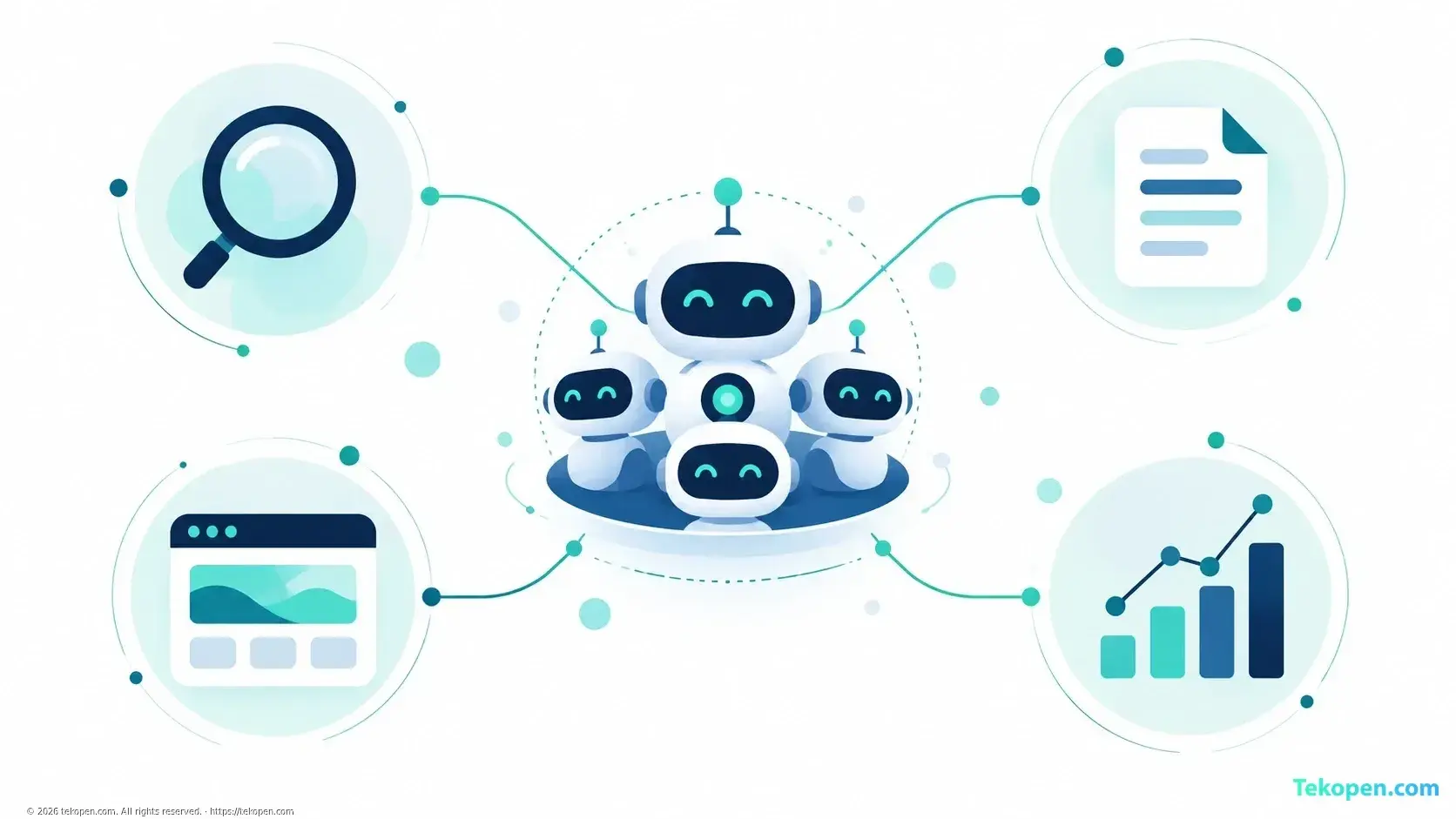
xAI’s Grok Bot Marketplace lists specialized bot templates for marketing, from market research and content briefs to ad reporting, website operations and tracking visibility in AI answers. The descriptions point to a notable organizational approach: dividing the marketing workflow into specific roles rather than assigning all the work to a general-purpose conversational assistant.
This information appears in Grok Bot Marketplace’s Marketing category. The cited content on the page does not provide launch dates, so there is no basis for determining when each bot template was listed. The capabilities below are descriptions from the category, not results from independent testing.
From writing content to dividing up the workflow
The bot templates do not focus solely on creating articles or ads. Product Marketer is described as learning about the product, brand, tone and positioning, then preparing content for landing pages and ads. Market Researcher monitors competitors’ websites, ads, pricing and public messaging on a schedule.
For implementation, Website Ops is presented as creating website changes in the form of pull requests—proposed source code changes to be reviewed before merging. This template is also tasked with checking the website’s SEO, content, speed, accessibility and other factors.
Project Manager coordinates research, positioning, landing pages, ads and analytics across the specialized bots. The structure described is therefore closer to a marketing team with assigned responsibilities than a standalone content-writing tool.
For small businesses, the practical value lies in each role’s output: research needs to provide a basis for messaging; messaging needs to become content; and content needs to be implemented and measured. However, the fact that the category lists these roles does not prove that they work together effectively in every environment.
SEO and visibility in AI answers are handled separately
Two notable templates are SEO & AEO Desk and AI Search Visibility. According to its description, SEO & AEO Desk turns keyword lists into content ideas and briefs detailed enough for writers to work from, using input from pasted lists or Search Console.
AI Search Visibility has a different scope: checking whether AI assistants and Google recommend the business, while also looking at which competitors are mentioned. It starts with a set of questions that buyers actually ask.
This division helps clarify two tasks that are often grouped together. One prepares content to meet search needs; the other observes how the brand appears in answers. AEO is commonly understood as optimizing content for answer systems, but the descriptions of these two bot templates do not promise rankings or recommendations by AI.
The results of a check also need to be understood within the scope of the questions and systems examined. They do not automatically represent the brand’s overall presence across every search engine or AI assistant.
Ad reporting can start with exported data
The category also includes templates for less prominent but recurring work. Marketing Analyst is described as using exported data to create weekly and monthly reports and monitor spending against thresholds. Paid Media Report Desk compiles data exported from Google Ads, Meta and LinkedIn into weekly reports with commentary.
Ad Spend Watch monitors spending and performance and can work with pasted data. Apple Search Ads Review examines spending against cost-per-install targets and drafts recommendations for changes to keywords, bids and budgets.
The common point is that not every task requires a direct connection from the outset. Exported data provides a more clearly defined scope for processing, although report quality still depends on the data fields, time period and measurement methods provided.
This task-based approach aligns with the principle in the article using AI to support your work: how to get started effectively: define the task and evaluation criteria before expanding the scope of use.
The boundary between recommendations and execution
Many descriptions clearly distinguish preparing outputs from taking action on live systems. Performance Marketer creates paused Google Ads search ad configurations to test messaging, with a review step before any spending. Apple Search Ads Review is described as not making changes directly to the account.
Distro Bot has a broader scope, covering campaigns, content and customer outreach, but its description states that the bot does not change spending, publish posts or send messages without approval. This is an important boundary between an assistant that makes recommendations and an agent that can affect budgets or brand image.
However, the wording in the category does not replace verifying access permissions and approval mechanisms during deployment. The article when AI agents need to ask permission further explains why permission to act needs to be defined according to the impact of each task.
For outputs more closely tied to sales, Lead Pipeline Desk is described as scoring leads, merging duplicate records and assigning owners using CRM data, spreadsheets or pasted content. The bot helps process the work, while CRM remains the system for managing customer information and workflows, not a role that can simply be assumed to be replaceable by a bot template.
Information that remains unconfirmed
The cited category pages are not sufficient to establish pricing, account requirements, usage limits, the scope of support in Vietnam or the availability of individual integrations. Nor do they provide independent evaluation results on report accuracy or implementation quality.
What can be confirmed from the current category is that Grok Bot Marketplace presents marketing as a sequence of specialized tasks, each with its own inputs, outputs and limits on action. Whether that structure can become a stable operational workflow still needs to be verified using real-world data and systems.
Related articles
Further reading
The new Mac mini and Mac Studio: Choose based on your workflow
How to create AI videos with Google Flow, from idea to individual scenes
OpenAI discloses a campaign to extract AI reasoning without authorization
OpenAI and America’s SBDC expand AI training for small businesses
AI goes grocery shopping: How does Safeway in ChatGPT help with shopping?