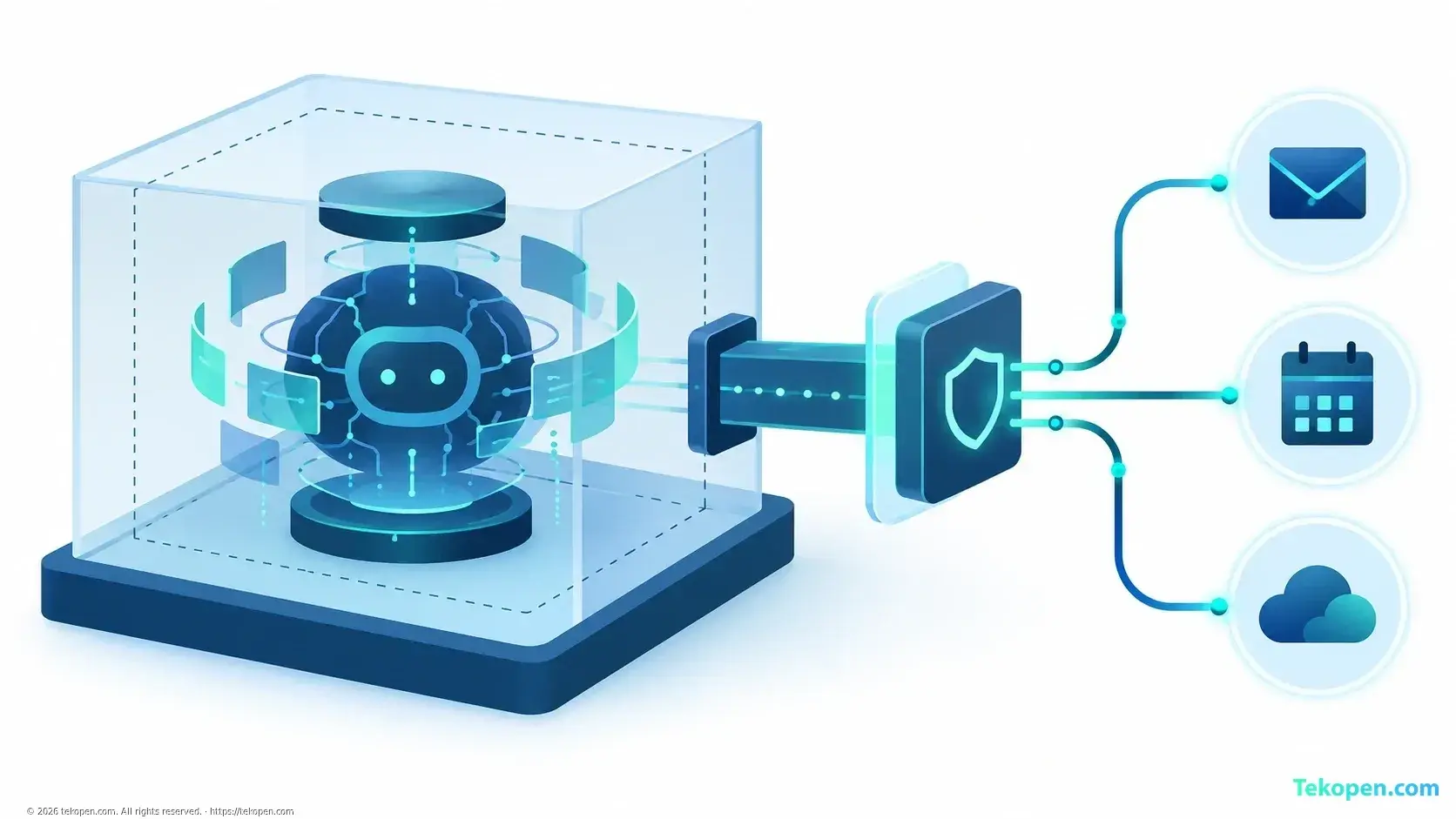
Meta has announced the security architecture for its Muse AI agent: the agent proposes actions, while the Sentinel layer decides whether to allow, deny or ask the user. This design is notable when AI is given access to email, calendars and business tools, rather than simply responding in a conversation.
In its technical announcement on Muse’s safety, Meta acknowledges that the agent can still make mistakes or be attacked through the data it reads. The system is therefore designed to limit damage when the model is misdirected.
Sentinel controls external actions
According to Meta, Sentinel sits outside the agent’s runtime environment, controlling actions through service connections and outbound network traffic. Muse cannot override this layer’s decisions.
When it needs to perform an action through a connection, Muse sends a request describing the service, action type, scope and task context. Sentinel checks it against the policies the user has set to determine the next step.
Permission to execute an action does not depend solely on the model following prompts: a separate component checks the request before execution. This is a concrete implementation addressing the question of when AI agents need to ask for permission.
Credentials remain out of the agent’s view
Meta says each user has a dedicated cloud computer, but the agent does not have full control over it. The environment for running tools and processing untrusted data is separated from sensitive services.
Credentials, including access tokens for connected services, are managed outside the runtime environment. Muse uses services through an intermediary mechanism rather than directly seeing authentication secrets.
This separation aims to limit the consequences if a website or email contains malicious instructions. Prompt injection attacks can cause AI to mistake external data for instructions it must follow. Separating permissions does not eliminate every risk, but it limits the possibility of model errors leading to unrestricted access.
Activity logs are not an absolute guarantee
In the introduction to Muse’s design, the development team describes activity logs, a list of approved permissions and memory files that can be read and edited. These tools help users review work running in the background.
Logs support traceability but do not replace checking results. An authorized action can still use incorrect data or produce unsuitable output, an issue related to context management when AI works on long-term tasks.
Meta also announced the launch of a Muse bug bounty program, offering up to USD 300,000 for valid reports. This is a measure to find vulnerabilities, not proof that the system is completely secure. The available documentation describes safeguards announced by the provider; it is not sufficient to conclude that they are effective in every operational scenario.
Frequently asked questions
Is Muse currently available in Vietnam?
According to Muse’s page for small businesses, the service is available to people aged 18 and over in the US and Canada. The provider has not specified when it will expand to Vietnam.
Does Sentinel require users to approve every action?
No. Sentinel can allow, deny or request approval depending on the policy, action type and scope of access, rather than always generating a permission prompt.