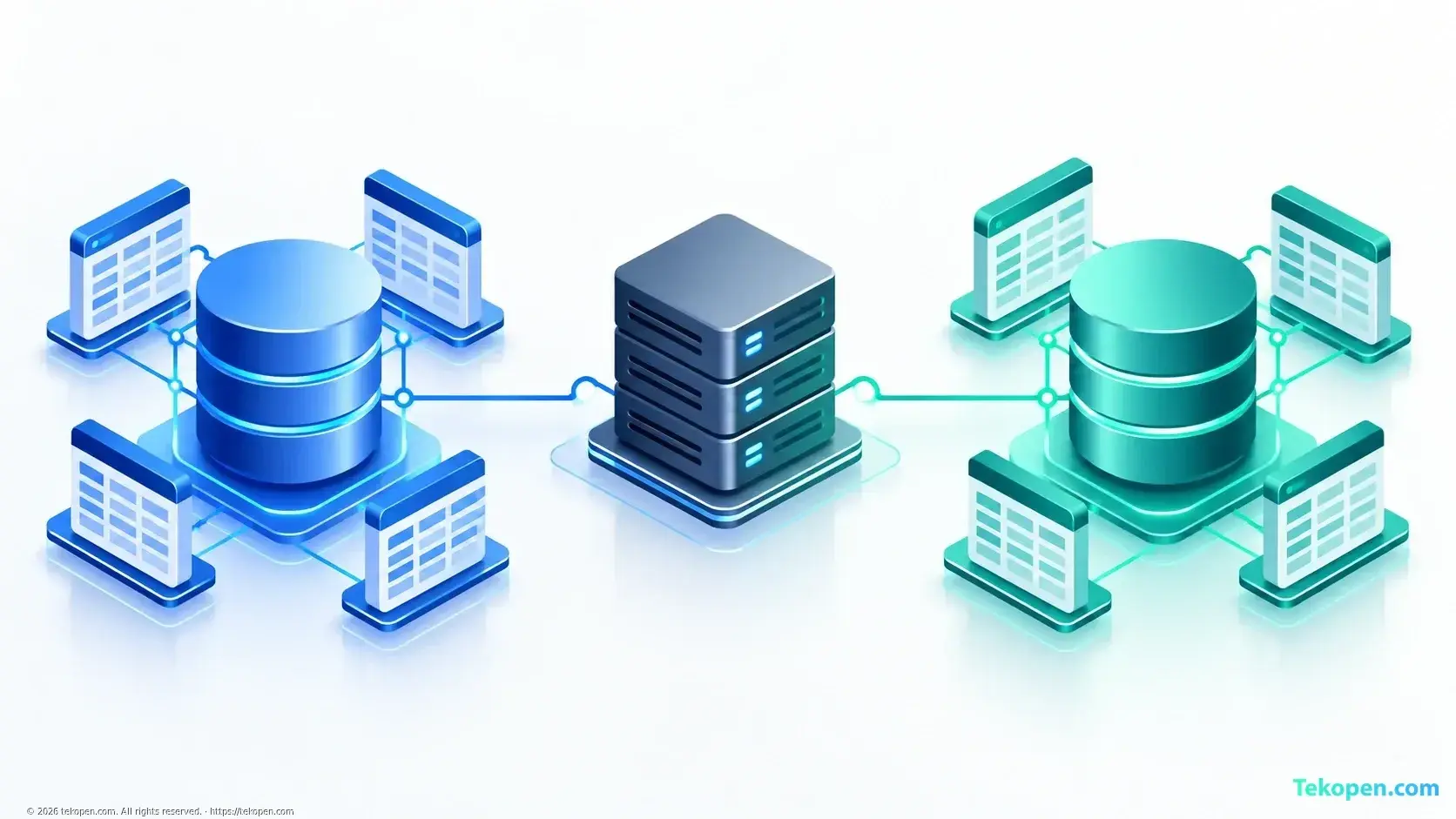
PostgreSQL is a good fit when an application needs rich data models, complex constraints and extensibility. MySQL is a good fit when compatibility with existing software and the web ecosystem is the priority. Neither system is always faster or better in every situation.
Both are open-source relational database management systems that support SQL, transactions and replication. The differences worth examining lie in data design, query optimization and operations.
PostgreSQL and MySQL Comparison Table
The MySQL discussion below covers modern versions using the InnoDB storage engine.
Criterion | PostgreSQL | MySQL |
|---|---|---|
Transactions | Supports ACID and MVCC | InnoDB supports ACID and MVCC |
Advanced Queries | CTEs, window functions and extensive SQL extensibility | Supports CTEs and window functions; syntax differences need to be checked |
Data Types | JSONB, arrays, ranges and custom data types | JSON and common data types for web applications |
Indexes | B-tree, GIN, GiST and BRIN; supports partial indexes | B-tree with InnoDB; JSON data is typically indexed through expressions or generated columns |
Extensibility | Extension ecosystem, including PostGIS | Plugins and many tools in the MySQL ecosystem |
Application Compatibility | Drivers, ORMs and software need to be checked | Common in hosting and applications such as WordPress |
Differences That Affect Design
Transactions and Integrity
You should not conclude that only PostgreSQL protects data well. MySQL with InnoDB also supports transactions, foreign keys and crash recovery. In both systems, data durability also depends on logging configuration, storage and backups.
PostgreSQL offers additional tools that are useful for complex models, such as exclusion constraints and the ability to defer certain constraint checks until the end of a transaction. These are worth considering when you need to prevent overlapping time intervals or update data with dependencies.
JSON and Complex Queries
Both handle JSON. PostgreSQL offers JSONB along with GIN indexes, which are convenient when you frequently search by document structure. MySQL can also query JSON and optimize frequently used attributes with suitable indexes.
Whichever system you choose, you should not put all your data into JSON just to avoid designing a schema. Fields that require relationships, constraint checks and aggregation should generally be explicitly modeled.
Which System Is Faster?
There is no universal answer. Performance depends on data distribution, indexes, the number of connections, queries and the level of write contention.
Before deciding, test a representative workload:
Use data with a size and distribution close to real-world conditions.
Measure p95 latency, throughput and resource usage.
Check execution plans with
EXPLAIN.Test concurrent reads and writes as well as long-running transactions.
A simple read benchmark is not enough to predict the performance of a business system with many tables.
Should You Choose PostgreSQL or MySQL?
Choose PostgreSQL if you are building a new application that needs analytical queries, geographic data through PostGIS or advanced business constraints. For ERP systems, these are criteria to evaluate, not reasons to automatically rule out MySQL.
Choose MySQL if your application already supports it well or your team has experience operating it. When installing WordPress on cPanel, follow the database requirements of WordPress and your hosting provider; PostgreSQL is not a direct replacement.
If you use a managed database service, review its recovery capabilities, failover and support. Learning how to read an SLA before subscribing to software also helps you avoid judging a service solely by its uptime figure.
Conclusion
PostgreSQL is worth prioritizing when you need flexibility in your data model; MySQL is worth prioritizing when compatibility and operational experience offer an advantage. Choose based on your application, then validate your choice through practical testing rather than the database management system's reputation.
Frequently Asked Questions
Can You Migrate from MySQL to PostgreSQL Without Changing the Application?
Adjustments are usually necessary. Beyond migrating data, you need to check data types, ID generation, SQL syntax, functions, collation and transaction behavior. An ORM can reduce the work but does not guarantee full compatibility.
Are PostgreSQL and MySQL Suitable for Large Systems?
Both can serve large systems if they are designed and operated appropriately. Scalability also depends on application architecture, connection management, replication and the data distribution strategy, not just the name of the database management system.
Are MySQL and MariaDB the Same?
No. MariaDB originated from MySQL but is a separate database management system, with increasingly distinct features and behavior. Even when software supports both, you still need to check versions and specific compatibility requirements.